Meet The Team





Supervisors

Keywords – Software Architecture, Artificial Intelligence, Requirements Analysis, Architecture Recommendation, Architecture Description Language (ADL), Sustainable Software Engineering, Design Patterns.
Project Abstract
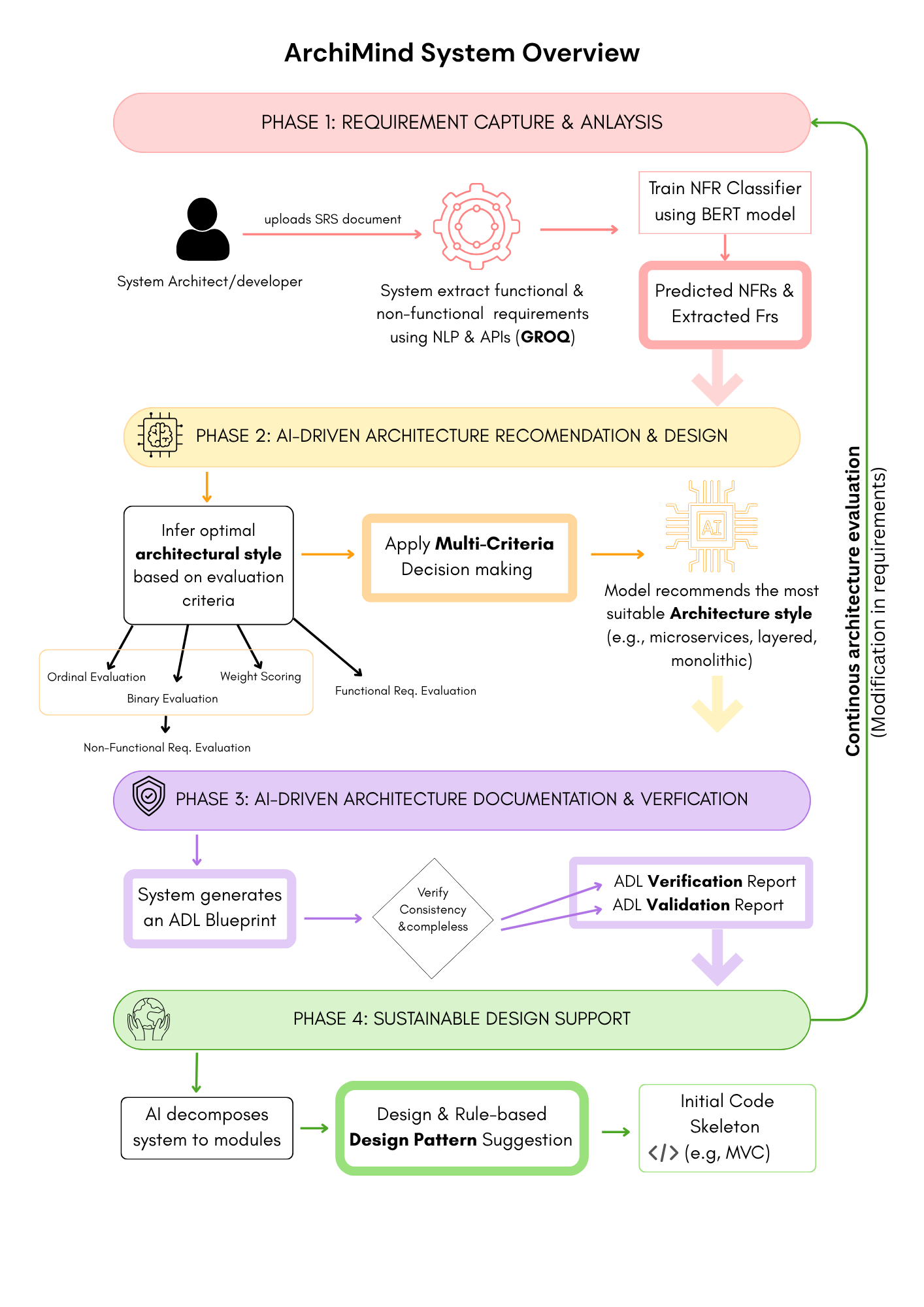
In software development, a common disconnect between requirements and architecture often leads to unsustainable practices. Choosing the wrong architecture can trigger system-wide failures, resulting in wasted resources, significant financial losses from redesigns, and high levels of technical debt. This project introduces a more sustainable development model by creating an intelligent assistant that embeds architectural integrity and longevity at the core of the process. The system promotes long-term sustainability by mitigating risk and resource waste from the outset. Instead of relying on manual guesswork, which can be error-prone and inefficient, it uses AI to analyze both functional and non-functional requirements like scalability and performance. This ensures the selection of an optimal architectural style—whether monolithic, microservices, or event-driven—that aligns with the project’s long-term goals and avoids the need for future overhauls. This approach directly contributes to economic and environmental sustainability by conserving the human and computational energy that would otherwise be spent on rework. A key element of this sustainable process is the formal documentation of the chosen architecture using an Architecture Description Language (ADL). This ADL blueprint acts as a durable, verifiable asset, ensuring the system is maintainable, transparent, and adaptable over its entire lifecycle. It prevents knowledge decay as teams evolve and provides a clear foundation for future development, drastically reducing long-term maintenance costs. From this sustainable blueprint, the assistant facilitates the design phase by structuring the system into clear modules, suggesting proven design patterns, and generating a foundational MVC code skeleton. This practice minimizes the accumulation of early-stage technical debt and establishes a clean, standardized structure that supports ongoing development and collaboration. Ultimately, this project demonstrates a shift toward a more responsible and sustainable software lifecycle. By systematically linking requirements to a formally documented architecture, it reduces reliance on non-renewable expert intuition, minimizes waste, and builds systems that are not only effective upon delivery but are also designed for longevity and efficient maintenance.
Project Objectives
– Reduce technical debt and costly architectural redesigns in software projects.
– Improve long-term sustainability, maintainability, and transparency of software systems.
– Automate the transition from requirements analysis to architecture and initial system design.
Project Scope
– Analyze functional and non-functional requirements using AI techniques.
– Recommend sustainable software architectures and generate formal ADL documentation
.- Support maintainable system design through modularization, design patterns, and MVC code skeleton generation.
Project Documentations
Proposal
SRS & SDD
Thesis
System Overview